
Make Better-Informed Choices at the Blackjack Table
 Available in US
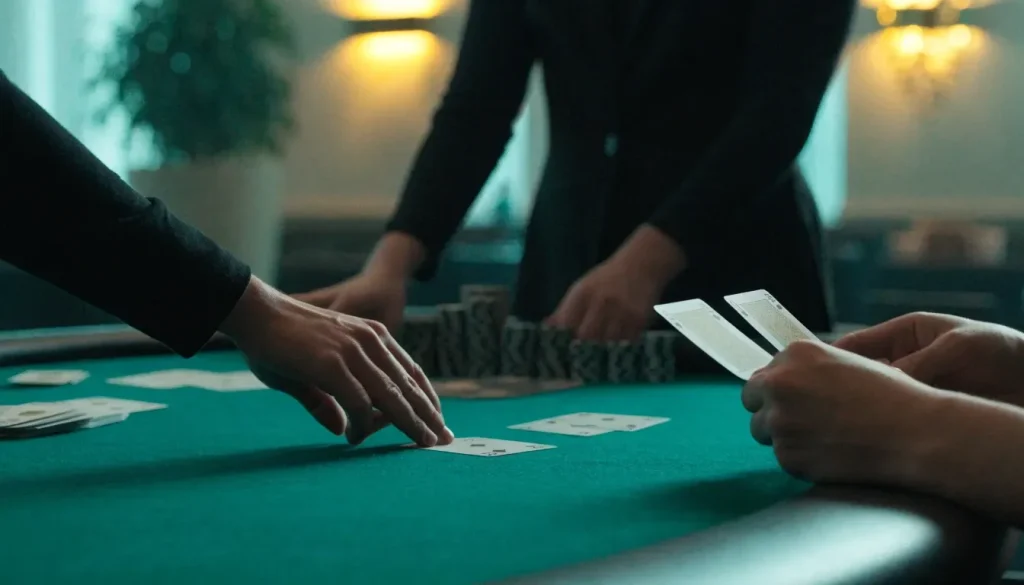
Understand how live hands play out, which rules and table features matter, and why no betting system can guarantee an edge.
How Blackjack Works—and Why Betting Systems Don’t Beat It
Blackjack has a simple objective: finish closer to 21 than the dealer without going over. If your hand goes above 21, it is bust; if the dealer goes over and yours has not, you win. A hand can also win by beating the dealer’s total while staying at or below 21. That is the basic answer to how blackjack works in a casino: you are competing against the dealer’s hand, not trying to reach 21 at any cost.
That distinction matters. A lower total can be enough if the dealer finishes lower, while chasing a higher one can push your hand over the limit. The aim is not to collect a particular total every time, but to end the hand in a better position than the dealer. Sometimes that means standing pat on a total that feels unimpressive. Sometimes a good-looking start still turns into a loss. No hand gives you control over what comes next.
I used to think the game could be made predictable if I found the right pattern. It cannot. Blackjack retains a house edge, so the casino has an advantage over time. That does not mean every hand is already decided, or that a player cannot win a session. It means the rules do not turn repeated play into a reliable way to make money. A win now is a result, not proof you have cracked the game.
When choosing a live blackjack casino, payout timing is one practical detail to consider alongside the game itself. Use these verdicts as a quick reference for the payout information available.
-
Chanze
- Payout speed
- 1-3 business days
Chanze lists a payout speed of 1-3 business days, giving you a stated timeframe to consider for withdrawals.
-
Revery Play
- Payout speed
- 1-3 business days
Revery Play lists payouts at 1-3 business days, so you have a stated processing timeframe to factor into your choice.
-
BeOnBet
- Payout speed
- 1-3 business days
BeOnBet gives a payout speed of 1-3 business days, a useful detail for you to check when considering withdrawals.
-
Dieselwin
- Payout speed
- 1-3 business days
Dieselwin lists a payout speed of 1-3 business days, providing you with a stated timeframe for payouts.
-
NightWin
- Payout speed
- 1-3 business days
NightWin's listed payout speed is 1-3 business days, which gives you a timeframe to bear in mind.
-
NightLuck
- Payout speed
- 1-3 business days
NightLuck lists payouts at 1-3 business days, offering you a specific timeframe to consider.
-
EvoSpin
- Payout speed
- 1-3 business days
EvoSpin states a payout speed of 1-3 business days, giving you a clear timeframe to factor into your assessment.
-
Zombillion
- Payout speed
- 1-3 business days
Zombillion lists a payout speed of 1-3 business days, a stated detail for you to consider when reviewing payout timing.
-
SpinFormula
- Payout speed
- 1-3 business days
SpinFormula gives a payout speed of 1-3 business days, providing you with a stated withdrawal timeframe.
-
Britsino
- Payout speed
- 1-3 business days
Britsino lists payouts at 1-3 business days, giving you a timeframe to consider when choosing a casino.
Betting systems do not remove that edge. Martingale is the familiar example: after a loss, increase the next stake in an attempt to recover the loss and finish ahead after a win. The catch is that losses can continue, and each increase puts more money at risk. A system can change the size and timing of your bets; it cannot ensure the dealer loses or make a losing run stop on cue.
I tried treating bigger stakes as a solution to bad luck. It felt like taking charge. Really, I was giving a run of losses more room to hurt me. The same problem applies to any staking plan that assumes a win will arrive before your money or patience runs out. A plan can organise your spending, but it cannot alter the game’s underlying advantage.
So, if you are wondering how to win at blackjack, separate the parts you can control from the parts you cannot. You can understand the objective and decide in advance what you are willing to spend. You cannot guarantee a winning hand, session, or outcome by following a betting sequence. A sensible approach is not a secret route to profit; it is a way to avoid mistaking a short-term result for a dependable strategy.

That is less exciting than a system promising to “beat the casino”. But the promise is the problem. Blackjack can be an entertaining game when you treat each stake as money you may lose, rather than an investment waiting to come back. Set a budget before you play and stop when you reach it. No chasing. No magic pattern.
Blackjack Rules to Check Before You Play
Before joining a live table, I read the rules shown for that specific game. The title may say blackjack, but that does not tell you what decisions the table permits or how it settles a hand. Casino blackjack rules are worth checking before you place a bet, not while the decision clock is running.
Start with the deal and the dealer’s instructions. Live dealers use physical cards from a standard deck, but the table information should still explain how the hand proceeds and what happens in situations that affect your choices. Check whether the dealer must draw or stand on particular hand totals, and whether the rules differ when the dealer has a soft hand. Don’t assume those details carry over unchanged from another table.
Then look at the options available to you. The interface may offer actions such as hitting, standing, doubling, splitting or surrendering; what appears can depend on the hand and the table’s rules. Read the prompts rather than clicking from habit. If you are unsure what an option does, open the help panel before joining. A button being visible does not mean it is available in every situation.
Also check how the table describes a natural blackjack and how winning hands are paid. The payout terms matter: a familiar game name is not a substitute for reading the displayed rules. I have been caught out by assuming a table worked like one I had played before. Small print, expensive lesson.
Some tables may offer side bets, which are separate wagers with their own conditions. Treat them as optional, not as part of the main hand, and read how each one wins before putting money on it. The interface may also include Bet Behind, allowing you to place a wager on another player’s hand rather than take a seat and make decisions for yourself. Check the table’s explanation of how that option works and what choices, if any, remain yours.
The useful test is simple: can you explain what each control does, what the dealer must do, and how the table settles the outcomes? If not, pause and read the rules panel again. UK blackjack rules are not one universal screen shared by every table; check the terms attached to the game you are actually opening. That takes a moment. Guessing can cost more.
What Live Blackjack Looks Like in Real Time
A live blackjack table is a video stream, not an animation dressed up to look like one. You see a human dealer working at a studio table, while your bets and other choices are sent through the game interface. The cards are dealt physically, and the footage reaches your screen as the hand unfolds. That combination is the main difference from a fully digital version: a real person is dealing, and you can watch the action happen.
I used to think the stream was mostly decoration around the same old buttons. That misses part of the appeal. Watching a dealer handle the cards gives the game a more social, tangible feel than tapping through a computer-generated round. It can also make the whole thing feel more exposed: there is a person on screen, and the table is moving along whether or not you are making a dramatic moment of your decision.

The interface still matters. You use it to place bets and take part in the game; the dealer does not take those actions on your behalf. The stream and the controls sit side by side, so your attention moves between what is happening at the table and what the screen is asking you to do. Once you know where those elements are, the presentation is fairly easy to follow. But it is still worth looking at the display rather than assuming every live table arranges its controls in the same way.
Some games include chat, which lets players communicate with the dealer and, in some cases, with other people at the table. That can add a bit of company to what might otherwise be a solitary session. You can say hello, react to the hand or ask something through the chat feature where it is available. You are not obliged to join in, though. I have found it perfectly comfortable to watch quietly and keep the chat panel out of the way.

Chat is not the same as being in a room with everyone. You are communicating through an on-screen feature, and the dealer is dealing with the table as a whole rather than having a private conversation with each player. If you prefer a low-key experience, the live feed can still work without much interaction. If you like a little social atmosphere, the messages may help. Neither approach changes what is happening with the cards.
There is also a small psychological shift when a human dealer is visible. A button press can feel abstract in a digital game; seeing the table makes the action feel more immediate. I have caught myself treating that atmosphere as if it meant the game was more personal or more favourable. It does not. The stream changes how the game is presented, not the underlying chance of a hand. A friendly dealer is part of the experience, not a reason to make a bigger bet or stay longer.
That distinction is easy to lose when the screen is polished and the chat is active. “Immersive” sounds like a promise of something special; in practice, it means you can watch a real dealer and interact through the interface. That may be exactly the sort of presentation you enjoy. It may also feel like extra theatre around a game you would rather play without a stream. No need to force it.

For me, the useful test is whether the live format helps me stay attentive or just gives me another reason to linger. The dealer, cards and chat create a more visible, shared setting than a digital table. They do not make the decisions for you, and they do not turn the game into a conversation with a personal host. It is still blackjack, shown in real time, with a human at the table and your controls on screen.
Live Blackjack Online in the UK: What to Expect
The main trade-off with live blackjack is straightforward: you get a more measured, streamed experience, but you can’t expect it to move like a digital game. A live table runs at a slower pace, so there is time between decisions while the game catches up. If you’re used to clicking through hands quickly, that pause can feel like part of the appeal—or like dead time.
I’ve found it helps to decide which you want before settling in. A slower pace can make a session feel less frantic, but it also means fewer hands in the same stretch of time. Don’t treat that as a reason to stay longer or raise your stakes. The clock still moves. So does the money.
The other practical difference is the entry point. Live blackjack tables have higher minimum bets than digital versions. That can rule out a table even if the game itself looks appealing, so check the minimum before you join and make sure it fits the budget you set beforehand. A polished stream doesn’t make a stake more affordable.
Your connection matters, too. Live games need stable internet. If the stream freezes or drops out, the experience can become frustrating just when you want to follow what is happening. I wouldn’t count on a weak or unreliable connection improving once a session is underway. If your connection is cutting in and out, it may be better to leave the table rather than keep trying to play through it.
Access also has a legal condition in the UK: a live dealer casino must hold a UK Gambling Commission licence to operate legally here. That is not the same as a promise that a particular table suits you. Check that the casino’s licence is current, then look at the table’s own minimum and terms. The licence is the baseline, not a reason to ignore the details.
- Verify that your internet connection is stable
- Check the table's minimum bet against your budget
- Confirm the operator holds a current UK Gambling Commission licence
- Review the pace of the live stream to ensure it suits you
Before you begin, take a moment to consider the pace, the stake required to join and whether your connection is steady. Those are ordinary practical checks, but they matter more than the studio’s lighting or a sales label like “premium”. I’ve been distracted by presentation before. It doesn’t change the conditions you’re playing under.
Live blackjack can be a poor fit if you want rapid play, a low entry stake or a connection that won’t hold a stream reliably. If the slower rhythm suits you and the table’s minimum fits your budget, it may be worth a look. Set a budget and stick to it; this is entertainment, not gambling advice.
Blackjack Games: Compare the Table, Not the Hype
A blackjack table can look familiar at a glance and still offer a different experience once you open it. I used to pick whichever title sounded liveliest, then discover I had not checked what the table actually offered. The label is marketing. The details matter.
Start with the rules shown for that specific game. Don’t assume that two tables with similar names play identically, or that a rule you saw at one table carries over to another. Read the table information before you sit down, and check the paytable as well. If a detail affects how a hand is handled or paid, it should be clear in the game’s own information. If you cannot find it, that is a reason to pause, not to guess.
Then look at the format and features. A live table may include side bets, which sit alongside the main game rather than replacing the need to understand its ordinary rules. They can make the screen look busier, but extra options are not automatically useful. I’ve learned to ask myself whether I understand what a side bet is asking me to predict and what its payout terms mean. If I don’t, I leave it alone. Simple enough.
Bet Behind is another feature you may see. It lets you place a bet behind another player’s hand, rather than taking a separate seat and playing your own hand in the usual way. Whether that suits you depends on how you want to take part; it is not a shortcut to better odds or a reason to ignore the table information. Check exactly how the option works in that game before using it.

Compare tables on practical points, not on words such as “premium”, “exclusive” or “immersive”. Those describe a sales pitch, not the conditions of play. Check whether the table’s rules are easy to locate, whether the available options make sense to you, and whether the interface makes it clear what you are selecting. If the wording is vague or the choices feel confusing, moving on is a perfectly sensible decision.
I also try not to treat a familiar look as proof that a game is interchangeable with another. A different table can present different options, and the rules attached to that particular game are what count. Take a moment to read them before you commit money. That small pause has saved me from playing on assumptions I could have checked.
A useful comparison is one you can explain in plain English: what the table offers, what its rules say, and which features you actually intend to use. You do not need to choose the busiest screen or the most elaborate title. You need a table whose conditions you understand. Less noise, fewer surprises.
How to Play a Hand Without Rushing Your Decisions
Before you join a live blackjack table, decide what you can afford to spend and treat that as the limit, not a target to reach. I used to think a quiet session meant I could keep going until something happened. That is how a small, planned spend turns into a decision you never meant to make. Set your budget before opening the table, and stop when it is gone. Don’t raise it to recover a loss or extend a winning run.
Once seated, take a moment to settle in rather than placing a bet just because the next hand is about to start. Keep your attention on the game and your own choices. Blackjack asks you to try to beat the dealer without going over 21, but that aim does not make every hand a reason to hurry or to stake more. If you feel distracted, frustrated or unsure what you have chosen, sitting out is a decision too.

During a hand, read the options shown on screen and give yourself time to choose. If you do not understand an option or the table’s instructions, pause to check them before acting; guessing under pressure is a poor habit. I have clicked through a decision simply because the round felt quick, then spent the rest of the hand wishing I had taken a breath. Not worth it.
Keep your stake within the budget you set, and avoid changing it in response to the last result. A run of wins does not mean you have found a reliable pattern, and a loss is not a cue to chase it. If you notice yourself trying to win back money or stay until you feel satisfied, step away. The game will still be there another time.
If you are new to the interface, a free-play version may help you become familiar with how decisions are presented. It is practice, not a way to earn money: free-play games do not pay real winnings. Do not let a smooth practice session persuade you that real-money play will feel the same once stakes matter.
I find a simple routine helps: choose a budget, take each decision at a calm pace, and leave when either the budget or your focus is gone. Blackjack is entertainment, not a way to make money, and this is not gambling advice. When the fun has stopped, stop playing.
Blackjack Casino Sites: Features Worth Checking
A live blackjack site is more than a page of tables. You are trusting it with your account, deposits and a real-time stream, so I look beyond the big banner before settling in. A polished lobby can still leave basic questions unanswered.
Check who is operating the site
For a UK player, the first check is whether the operator holds a current UK Gambling Commission licence. Live dealer casinos can operate legally in the UK when they have that licence; a familiar-looking logo or a claim about regulation is not a substitute for checking the operator’s status.
I used to treat the footer as decorative and click straight through to the games. That was backwards. Find the operator’s legal name and licensing information, then make sure it matches the business running the site. If you cannot tell who is taking your deposit, stop there.
See how the live area works
Live blackjack is streamed from a studio, where a human dealer handles the game, while you place bets through the site’s on-screen controls. Before committing, see whether the live area loads cleanly on the device you plan to use and whether the controls are easy to follow. A stream that stutters or an interface that makes it hard to see what you have selected can turn a straightforward session into a frustrating one.
You do not need to register blindly just to admire a lobby. Look for clear descriptions of the live offering, accessible help pages and a way to understand how the site presents its games. I would rather spend a few minutes checking the layout than discover mid-session that I cannot find the account or support controls. Small checks. Less hassle.
Read the account and payment information
Before creating an account, check the deposit and withdrawal terms, the payment methods shown, and whether the site explains how transactions are handled. Do not use a credit card for gambling in the UK: operators cannot accept credit-card payments for gambling, including credit-card funding routed through a money service business. Wallets funded by credit cards cannot be used for gambling either.
The site should make its account conditions understandable before you deposit, not hide them behind vague promotional language. If a payment option or a withdrawal condition is unclear, ask support before putting money in. A quick answer is useful; evasive wording is not.
Judge support and safer-play controls
Find the customer-support route before you need it. Check whether the site explains how to contact support and where to find account and safer-gambling controls. You should be able to locate these without having to dig through promotional pages. Set a budget before playing and stick to it; a site’s tools can help you manage your account, but they cannot make decisions for you.

Finally, treat claims such as “best” as advertising, not evidence. A site may look slick and still be a poor fit if its terms are hard to locate or the live area does not work well for you. This is entertainment, not gambling advice. Take time to verify the operator and understand the account conditions before you play.
Finding a Casino That Offers the Blackjack Experience You Want
I’d start with the kind of session I actually want, not with a casino’s headline. If I’m after the feel of a live table, I look for live blackjack specifically; a general blackjack label may also include digital games, which move at a different pace.
That distinction matters. Live games take longer than digital versions, so they suit me when I’m happy to give a hand my attention rather than fit play into a quick gap. If I’m impatient or likely to feel rushed by a slower game, the live format may not be a good match. No glossy table image changes that.
I also check whether the minimum bet fits the amount I’m prepared to spend. Live blackjack can start at a higher minimum than digital blackjack, and a table that looks appealing is no use if its entry level pushes me beyond my budget. I’ve made that mistake: choosing the table first and thinking about the stake afterwards. Bad order.

Connection is part of the fit, too. A live table needs a stable internet connection; if mine keeps dropping, the experience can become frustrating. I’d rather choose a time and place where I can stay connected than join a table and hope the stream holds up.
Once I know those preferences, I can narrow down casinos that offer the live format without assuming that every table, or every casino, will suit me. I don’t treat a label or a promotional image as proof that the setup matches what I want. I check the actual live-table options and their stated minimums before settling in.
This is for entertainment, not gambling advice. I set a budget before playing and stick to it.
Choosing a Blackjack Casino Without Falling for the Sales Pitch
When you’re trying to find the best blackjack casino in the UK, it’s easy to get pulled towards the biggest banner or the most confident promise. I’ve made that mistake. “Premium tables” sounds like a reason to sign up; it tells you very little about whether you’ll enjoy sitting at one. I’d rather judge the offer by what I can verify and whether the way it works suits me.

Start with the legal basics. A casino offering real-money gambling to people in Great Britain must hold the relevant UK Gambling Commission licence. Check the operator’s licence status through the Commission’s own information, rather than treating a badge or a line of promotional copy as proof. A polished site is not a substitute for regulation.
Then look at the blackjack itself. A casino can have an impressive-looking live lobby and still offer little that fits your preferences. Check what tables are actually available and read the rules shown for the particular game you might play. Don’t assume that a label such as “classic” means the conditions are identical across tables. The details matter more than the sales language.
I also try to imagine the session, not just the first click. Live games move more slowly than digital versions, and their minimum bets are higher. That can make a live table a poor fit if you want quick rounds or need a very small stake to feel comfortable. A stable internet connection is necessary, too; if your connection drops or stutters, the experience can become frustrating. None of that makes a casino good or bad on its own. It tells you whether the format works for you.
Separate the offer from the experience
Promotions can make an ordinary offer look exceptional. So can phrases such as “exclusive access” or “VIP treatment”. I read those as advertising until I can connect them to something concrete: an available table, clearly stated conditions, or a feature I actually value. If the wording is broad but the practical details are hard to find, I don’t give the wording much weight.
I keep a short comparison in my head: Is the site licensed for the UK market? Can I find a live blackjack table that suits my preferences? Are its conditions clear before I join? Can I play at its pace without feeling pushed to raise my stake? If one answer is no, a larger lobby or louder promotion does not fix it.

That isn’t an operator ranking. “Best” depends on what you want from a session, and one casino’s selection may suit you better than another’s without being universally superior. I wouldn’t treat a recommendation as evidence that the tables will suit my budget or that the experience will run smoothly on my connection. Verify the details yourself.
Don’t let a system sell you certainty
A casino may present blackjack as a game of skill or strategy, but that should not be read as a promise of profit. The house retains an edge. Staking plans such as Martingale can still lead to losses; increasing bets after a loss does not remove the underlying risk. I once found that out by concentrating on the plan and ignoring how quickly the stakes could become uncomfortable. Bad trade.
Set a budget before you play and stick to it. Don’t raise it to recover losses, and don’t keep going just because a session started badly or was going well. A casino that suits you should not need you to abandon your own limits. If the site’s tone makes you feel hurried, or its presentation keeps nudging you towards playing more, take that as a reason to pause rather than a challenge to keep up.

My test for a good fit is deliberately unglamorous: the licence checks out, the table conditions are understandable, the pace and minimum stake are manageable for me, and I can leave when I planned to. That beats a “best casino” label that could be pasted onto any page. No magic pick. Just fewer surprises.
This content is for entertainment purposes only, not gambling advice.
Blackjack Bonuses: Read the Terms Before You Opt In
A bonus can look like extra room to play, but the headline is only the start. Before accepting a blackjack casino bonus, I’d check whether live blackjack is eligible at all, how much it contributes towards wagering requirements, and what other conditions apply. If you skip that small print, you can end up playing a table that barely moves the bonus requirement.
A specialist review of UK welcome offers describes many as free spins for slot games, which cannot be used at live tables. That is not a guarantee about every offer: check the current terms for the specific promotion. If your aim is to play live blackjack, a slot-focused offer may simply have no practical use for you.

The contribution rate matters too. Some live games count for only a small share of the wagering requirement; terms may assign blackjack a 10% weighting. In plain English, eligible blackjack stakes would make much less progress than games counted in full. Check whether blackjack is included, which versions qualify, and whether the weighting differs by game. Don’t infer the answer from the banner.
Also read the rules on maximum bets while a bonus is active, eligible deposits and withdrawals, and when the offer expires. Those conditions can affect whether you can complete the requirements. I’ve learned not to treat “welcome” as meaning uncomplicated. It’s marketing.
A blackjack casino bonus offer advertised as “no deposit” still needs a close read. Confirm what the offer actually provides, which games are eligible, and whether wagering conditions apply before you spend time trying to use it. The label alone does not tell you whether live blackjack is included or whether any resulting winnings can be withdrawn without meeting further terms. The same checks apply when comparing no-deposit offers from different casinos.
If the terms are unclear, or the bonus steers you towards play you did not plan, leaving it alone is a reasonable choice. Set your gambling budget before you sit down, and don’t increase it to chase a promotion. A bonus is not a reason to play longer or spend more.
This article is for entertainment purposes only, not gambling advice.
How do you play live roulette?
Place your bets through the on-screen interface, then watch the live dealer spin a physical wheel. You win when the ball lands on a number you selected.
How can you win live dealer roulette?
You win when the ball lands on a number you bet on. Roulette outcomes are uncertain, so no betting method can guarantee a win.
Why does the dealer always win in blackjack?
The dealer does not always win: you win a hand by finishing closer to 21 than the dealer without going over. The casino has an advantage over time, but individual hands can go either way.
Games: UK Casino Game and Slot Guides
Content created by the «rendersbyshailesh» team
