
Check what sits behind the Plinko label
 Available in US

The Plinko name alone does not confirm which game is offered, whether it is available or how the casino and its payment options work.
Playing Plinko Online: What the UK Casino Setting Changes
Seeing Plinko mentioned alongside casino games can make it sound as though there is one standard online experience waiting for you. That is not a safe assumption. “Plinko” tells you what you are looking for, but it does not by itself confirm which version a casino offers, whether it is available to you, or what sits behind the label.
Online casinos bring casino games onto a digital platform where gambling is permitted by law. In practice, that changes the setting: instead of walking into a venue and asking what is available, you encounter games through a website or app. A title may appear in a lobby, a search result or a promotional panel, but seeing its name is not the same as knowing what the game is like to use. I have learned not to let a familiar label do the checking for me.
That distinction matters with Plinko because the search for an online casino with the game can blur several different questions. Is Plinko actually offered there? Is the page describing a particular game or using the name loosely? Is the casino operating in the UK regulatory space? Those are separate checks, even when a page presents them as one neat promise. A polished banner answers none of them on its own.
If you’re choosing a UK casino for Plinko in 2026, payout speed is one practical detail to consider. Use these short verdicts as a quick reference when weighing your options.
-
Chanze
- Payout speed
- 1-3 business days
Chanze lists a payout speed of 1–3 business days, a useful detail for you to consider when choosing a casino.
-
Revery Play
- Payout speed
- 1-3 business days
Revery Play lists a payout speed of 1–3 business days. Keep this timeframe in mind as you assess whether it suits you.
-
BeOnBet
- Payout speed
- 1-3 business days
BeOnBet lists a payout speed of 1–3 business days, giving you a stated timeframe to factor into your choice.
-
Dieselwin
- Payout speed
- 1-3 business days
Dieselwin lists a payout speed of 1–3 business days. This is the available detail to consider when deciding if it fits your preferences.
-
NightWin
- Payout speed
- 1-3 business days
NightWin lists a payout speed of 1–3 business days, which you can take into account when comparing your options.
-
NightLuck
- Payout speed
- 1-3 business days
NightLuck lists a payout speed of 1–3 business days. Consider this stated timeframe as part of your decision.
-
EvoSpin
- Payout speed
- 1-3 business days
EvoSpin lists a payout speed of 1–3 business days, giving you a clear payment timeframe to consider.
-
Zombillion
- Payout speed
- 1-3 business days
Zombillion lists a payout speed of 1–3 business days. You can use this information when considering your options.
-
SpinFormula
- Payout speed
- 1-3 business days
SpinFormula lists a payout speed of 1–3 business days, a practical detail for you to weigh in your choice.
-
Britsino
- Payout speed
- 1-3 business days
Britsino lists a payout speed of 1–3 business days. This stated timeframe may help you assess whether it suits your preferences.
The UK setting adds a further layer. A specialist review has described the 2026 online casino landscape as having two sides: UKGC-regulated services and offshore platforms outside that system. That is a description attributed to a type of source, not a guarantee that every site fits neatly into a simple comparison. The important point for a player is that a site’s presentation and its regulatory position are not interchangeable. A page that welcomes British visitors is not, just for that reason, a UK-licensed casino.
I would start by treating any mention of Plinko as a lead, not a confirmation. Look at the operator and the actual game information rather than relying on a search snippet or a headline. If the page is vague about what is being offered, that vagueness is worth noticing. It is easy to assume that two casinos using the same word mean the same thing. They may not be describing an identical product or experience.
This is also why “best” is a slippery word in casino copy. It can mean a game is easy to find, that a site promotes it heavily, or simply that a writer wants a click. Those meanings are not the same as evidence that a particular casino is suitable for you. I have been burned by taking confident wording as a verdict. It is marketing. Read past it.
 Games: UK Casino Game and Slot GuidesBrowse pages on UK casino games, slot types and casino providers, including reel slots, volatility, RTP, bingo, craps and game shows.
 Playtech Casinos in the UK: Games and OffersLearn how to check Playtech slot rules, compare UK casino features, and review bonus terms before choosing a game or offer.
At this stage, there is no need to decide whether Plinko is for you, or to compare possible stakes and outcomes. Those questions belong to the game and gambling choices themselves. First establish what the online setting does and does not tell you: a casino may offer games online where the law allows, but the presence of a casino-style page does not independently confirm a particular Plinko title, its terms or the operator’s status.
Keep the basic distinction in view. Online means the game is presented through a remote service rather than a physical casino floor; UK means the operator’s relationship to the British market matters too. A site can use familiar casino language while operating outside the UKGC framework. Conversely, a label or image that looks convincing cannot establish that a game is available through a locally regulated operator. Check the service behind the page, not just the game name.
I find it useful to separate curiosity from confidence. You might be exploring what Plinko looks like online, or checking whether a casino you already use lists it. Either way, do not let the word “online” imply that every version is alike, or let “UK” in a page title settle the licensing question. Those are claims to verify, not details supplied by the name.
So, when you come across Plinko in an online casino context, take it as the start of the investigation. The digital format changes where you encounter the game; the UK market makes the operator’s regulatory position part of the picture. Beyond that, a title alone tells you very little. Keep your expectations modest. Check first.
Plinko as a Casino Game: The Categories Behind the Screen
The word “game” can mean several different things in a casino. Some games are built around numbers generated by software; others are presented as gambling machines, while table games put a dealer or croupier in the action. That distinction matters when you encounter Plinko online, because a familiar board-style appearance does not, by itself, tell you how the game is classified or what produces its outcome.
A useful starting point is the random-number game. In this category, a computer or other gaming equipment generates selected random numbers. The software uses those numbers as part of the process that determines an outcome. The player interacts through a screen, but there is no dealer making decisions on each turn. The key feature is the random-number system behind the display, not whether the graphics resemble a physical game.
That can be easy to overlook. A bright board, bouncing pieces and a visible path suggest a physical object moving through a physical space. Online, though, what you see is an interface. Its animation may show an event unfolding, but an animation is not evidence that the result is being decided in the same way it would be at a table or in a room with a real board. I’ve learned not to treat convincing presentation as an explanation of the mechanism. Looks familiar; still need to know what is behind it.
 Slingo Casinos in the UK: Rules and Game ChecksLearn how UK slot controls affect Slingo, what to check before depositing, and why availability should be verified. Autoplay is not allowed.
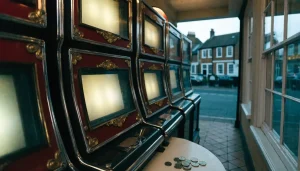 Penny Slot Machines in the UK: Stakes and SpinsLearn how penny slots are defined, how paylines affect each spin, and what to check when playing online; the working threshold is…
Gambling machines and the solo format
Gambling machines are generally designed for one player at a time and do not need a casino employee to operate them. In an online casino, the screen can fill that same broad role: you make an input, the system processes the play, and the result appears without a croupier running a shared game.
That does not mean every screen-based casino game is automatically a machine game in every formal or technical sense. It is better to separate the format from the classification. A solo experience with no dealer involvement may feel machine-like, but the game’s actual category depends on how it is defined and operated. For Plinko, the name and visual style alone are not enough to settle that question.
It also helps to distinguish the experience from the underlying system. You may see a sequence of movement across a board, but what matters is whether the outcome is generated by random-number technology, another form of gaming equipment, or some different arrangement. Without reliable details about a particular title, I would not assume that all games carrying the Plinko label work identically. Same label, not necessarily same setup.
How table games differ
A table game has a different social and operational structure. Players compete against the casino rather than against one another, and a croupier or dealer usually conducts the game. The dealer is part of the visible process: managing the table and carrying out the actions that move play along.
Random-Number Games
Outcomes are determined by computer-generated numbers via software, regardless of the visual interface.
Gambling Machines
Designed for solo play without the need for a casino employee or croupier to operate the game.
Table Games
Dealer-led experiences where players compete against the casino in a shared operational structure.
That contrast can make Plinko feel closer to a gambling machine than a traditional table game when it is offered as a self-contained screen experience. There is no need to imagine a dealer standing behind the screen. But appearance is not enough to say that a particular Plinko product belongs to a specific category; the operator’s description and the game’s underlying setup matter.
Table play can also involve an atmosphere that a solo digital game does not recreate: a shared table, a dealer, and other players taking part in the same setting. An online game may borrow visual cues from physical play without reproducing that structure. So when you compare a Plinko-style title with a table game, look past the theme and ask who or what is actually conducting the game.
What the categories tell you
These categories are a way to understand the casino landscape, not a shortcut to judging a specific title. Random-number games are defined by the role of computer-generated or equipment-generated numbers. Gambling machines are commonly played solo without staff involvement. Table games are generally dealer-led and set players against the casino. Those descriptions explain broad formats, but they do not confirm the mechanics of an individual Plinko game.

I would start with the information supplied for the title rather than infer details from a falling-piece animation or a “slot” label. The terms used by a casino can describe how a game is displayed or grouped on its site; they do not necessarily tell you exactly how its outcome is produced. If the explanation is thin, that is a reason to stay cautious about what you think you understand—not a reason to fill in the gaps yourself.
The practical takeaway is modest: a casino game can look like a machine, feel like a board game, or borrow the language of a slot, while its category depends on the system and format behind the screen. For Plinko, keep those ideas separate. Presentation is one thing. Classification is another.
Real-Money Plinko: Stakes, Random Outcomes and the House Edge
Real-money Plinko means putting cash, or chips bought with cash, at risk on the result of a game. If the outcome goes your way, you may finish a round ahead; if it does not, the stake is lost. That sounds obvious, but I used to focus on the possible win and treat the stake as though it were only a ticket to get there. It is still money you are choosing to gamble.
The important distinction is between a possible short-term gain and the longer-term structure of casino play. A casino game can pay out during an individual session while still giving the casino a predictable advantage over sustained play. Those two things are not contradictory. A good result can happen now; it does not mean the game has become favourable to the player overall.
That is the house edge in practical terms: not a promise that every round will go against you, but a structural advantage that matters across repeated gambling. I find it easier to think of it as the cost built into playing, rather than as a prediction of what will happen next. It does not tell you whether your next stake will win or lose.
What a stake really means
With a real-money Plinko game, each stake is a fresh amount exposed to an uncertain result. The money does not become safer because you have already lost a few rounds, and a run of wins does not make the next one a sure thing. Treating recent outcomes as a signal is one of the easiest ways to start staking more than you meant to.
I have made that mistake in other casino games: after a loss, I wanted a quick recovery; after a win, I felt I had room to press on. Both feelings made the next decision seem more reasonable than it was. Neither changed the underlying trade-off. The stake was still at risk, and the casino still had the long-term advantage.
Before you start, decide what amount you are prepared to lose and regard it as spent once it is in play. That is not a method for beating the game. It is a way to stop a session from quietly turning into a chase. If the money is needed for bills or other essentials, it is not a sensible stake.

Can you win real money?
Yes, a real-money casino game can produce a short-term gain. But no general description of Plinko can promise that you will win, tell you when to stop, or provide a reliable system for turning repeated play into profit. A run of favourable results is possible; so is losing the money you staked. Neither outcome proves what the next round will do.
That is why claims about a “winning strategy” deserve a hard look. A betting pattern may change how much you put at risk from one round to another, but it cannot remove the casino’s long-term advantage. Increasing a stake after a loss can make the losses larger; increasing it after a win can put those winnings back at risk. The excitement of a changing balance is not evidence that a strategy works.
For anyone considering real-money Plinko in the UK, the useful question is not how to guarantee a win. There is no guarantee. Ask whether you are comfortable losing the amount you plan to stake, whether you can stop when you intended to, and whether the game is being offered by a legally licensed operator. If the answer to the first two is no, walking away is a better decision than trying to solve the game by staking harder.
I still think the blunt version is the clearest: short-term wins are possible, but the long-term edge belongs to the casino. Keep that in view before you risk cash. It matters more than the promise of a big result.
Free Plinko Play: A Way to Explore Without a Stake
Free play appeals for a simple reason: you can look at a game without putting your own money into it. That can make sense if you are curious about Plinko but are not ready to gamble, or if you want to see whether the format holds your attention before deciding what to do next. The important distinction is that a no-cash session is not the same thing as playing for money.
I’ve found it useful to separate those intentions in my head. When there is no stake, a result cannot grow your balance or take money from it. You may still be watching outcomes and making choices, if the version offers choices, but there is no cash result to interpret. It is exploration, not a way to judge what a paid session will earn.
That also means free play should not be treated as a reliable guide to a Plinko casino payout. A run of favourable results without a stake says nothing about what you would receive with money involved. Casino games are built around random outcomes, and their long-term structure gives the operator an advantage. A free session does not remove that structure; it removes the financial consequence for you.
What you can learn without paying
If a free mode is available, use it to pay attention to the experience rather than chase a pattern. Does the game make its controls clear? Can you follow what is happening on screen? Do you enjoy the pace? Those are useful things to notice before gambling. A few pleasing results are not evidence that another session will behave the same way.

I used to give a lucky streak too much credit. It felt like I had spotted something, when all I had really seen was a short sequence of outcomes. Free play can help you recognise that impulse without having a stake riding on it. Still, it cannot tell you that the next paid round will match what you just saw. Short sessions are a poor crystal ball.
There is another limit: “free” can mean different things in different contexts. A genuinely no-stake mode is not the same as a promotional reward that comes with conditions, and free spins are not automatically the same as free Plinko play. If an offer is attached, its terms matter; the word itself does not explain what you must do or what restrictions apply. Keep that distinction clear.
Keep the expectation modest
People looking to play free Plinko casino games may expect a practice version to be available wherever the game is mentioned. That is not something to assume. The same goes for a Plinko slot, an Android download, or a button labelled demo: the format and access can differ between platforms. Don’t install anything or hand over personal details just because a page uses the word “free”. Check what the option actually does.
If there is no no-stake mode, you do not have to replace it with a deposit just to satisfy your curiosity. You can leave the game alone, or simply wait until you have clearer information about what is being offered. I’ve made the mistake of treating a small first payment as a harmless way to “have a look”. It still puts money at risk.
Do
- Use free play to check controls and usability
- Observe the pace of the game
- Verify the terms of promotional free offers
Don't
- Use free results to predict paid outcomes
- Install software just because a page says "free"
- Assume a demo is available at every site
Free play is most useful when you want to explore presentation and basic usability without financial pressure. It cannot prove that a game is profitable, predict a paid outcome, or guarantee that a particular casino offers a free version. Keep it in its lane. Curiosity, not a promise.
How to Read a Plinko Casino Offer Before You Play
A bonus can look generous while its conditions do the real work. I used to notice the headline and skip the small print; that was a quick way to misunderstand what I was agreeing to. With a Plinko offer, treat the promotional banner as a starting point, not the full deal.
Start with the wagering requirement: how much you must stake using bonus funds before the offer’s conditions are met. Since 19 January 2026, UK rules cap wagering requirements on gambling incentives at 10x the bonus funds. So an offer requiring more than that is not within the current cap. Check the wording carefully: the multiplier applies to the bonus funds, not automatically to your deposit as well. The terms should make clear what amount the requirement is calculated against.
Then look at which products count. An incentive cannot make you gamble across different product types to unlock a reward. A casino offer, for instance, cannot require you to place bets on sports as well as play casino games. If the promotion bundles those activities into one set of conditions, that is a warning sign. The offer should stand on its own terms, without a second gambling product hidden in the route to completion.

I also look for the conditions that explain when the offer applies. Who is eligible? What actions qualify? When does the offer end, and what happens if you do not meet its conditions? Those details should be displayed clearly, not left for you to piece together from a banner and several separate pages. If the wording is vague, I do not assume the most favourable interpretation.
For Plinko specifically, do not assume that every stake or game session will count towards a promotion just because the game is available at the casino. Read the offer’s eligible-game wording before you opt in or play. If it does not clearly say how Plinko play is treated, ask the operator before committing money. That is less exciting than clicking “claim”. It is also less expensive than guessing wrong.
One useful check is to separate the bonus amount from the money you deposit and from any winnings. The terms should tell you which balance is subject to wagering and what conditions apply before funds can be withdrawn. Avoid relying on a support reply that contradicts the written promotion: keep a copy of the offer and its terms as they appeared when you accepted it.
- Check if wagering requirements are within the 10x cap
- Confirm Plinko is listed as an eligible game
- Verify that no other product types are required to unlock the reward
- Clarify which balance is subject to wagering
Finally, compare the headline with the full conditions. A large-sounding bonus does not tell you whether the wagering requirement is manageable, whether the relevant game is included, or whether the offer fits your plans. I have learned to read those lines before I play, not after. If a promotion is hard to understand, leaving it alone is a perfectly sensible choice.
Plinko Casino Sites: UK-Licensed and Offshore Are Not the Same
A site can accept players from Britain without being licensed to serve them here. That distinction matters more than a polished page, a familiar payment logo or a game labelled Plinko. Offshore casinos may take UK players while operating outside the UK Gambling Commission’s system. Their availability does not make them UK-licensed.
For British residents, the rule is clear: since the Gambling (Licensing and Advertising) Act 2014, an operator taking bets from them must hold a licence. The UKGC framework is the relevant one for legal online gambling in the UK. A licence issued elsewhere is not a substitute for a UKGC licence.
I used to treat “available in the UK” as if it meant “approved in the UK”. It doesn’t. A platform might be reachable, let you register, and display a Plinko game, while still sitting outside the protections and oversight attached to a UKGC-licensed operator. That gap is the point—not a technical footnote.
Terms such as “non GamStop sites” are often used for offshore platforms, but the label does not tell you whether a particular site is licensed to take bets from British residents. Nor does a Plinko-themed page establish that the game, a slot version or a no-deposit offer is authorised here. Those are separate claims; the site’s regulatory status comes first.

When someone asks, “Is this Plinko casino legit?”, I’d start with the operator, not the game name or the sales pitch. Check whether the operator holds a current UKGC licence for the gambling it offers to people in Britain. If it operates outside the UKGC system, it is not a UK-licensed casino, even if it accepts British customers.
That distinction also helps keep “Plinko casino sites” and “Plinko gambling sites” in perspective: the words describe what a page offers, not whether it has the required permission to serve the British market. Don’t confuse access with authorisation. It’s a costly mix-up.
Choosing a Plinko Casino: Check the Evidence, Not the Superlatives
When I see “best Plinko casino”, I want to know what that label is based on. A ranking can look decisive while telling you little about whether the game is actually available, what the terms say, or how the site handles your account. I’ve learned not to treat a confident headline as proof.
Start with the claim itself. Does the page explain how it assessed the options, or does it simply stack up praise words? If it calls a game a Plinko slot, check that the description really concerns a slot and not another casino game being presented under a familiar label. Names and categories can blur in promotional copy. A polished screenshot is not much evidence either.
Then look for specifics you can verify on the operator’s own pages: the game’s rules, the offer terms, and any stated restrictions. If a review makes a claim but gives no way to check it, I treat that as marketing, not a finding. Same goes for “instant”, “exclusive” and “top-rated”. Those words sound useful. Often they aren’t.
Bonuses deserve particular scepticism. A no-deposit bonus means you can receive a casino bonus without spending money; it does not, by itself, tell you whether winnings can be withdrawn or what conditions apply. Read the offer terms rather than assuming the label means cash with no strings attached. For other promotions, compare the stated requirements with what you would actually need to do to qualify and withdraw.
I also separate a site’s claims from independent commentary. Reviews can help you spot questions worth asking, but a ranking is not a guarantee and may reflect the reviewer’s priorities. If several pages repeat the same superlatives without showing their basis, repetition does not make them stronger evidence.
The same approach applies when someone names a “best” Plinko slot in the UK. First establish that the product exists in the form described; then assess the details, not the adjective. I’d rather have a plain explanation I can check than a shiny verdict I can’t. Show me the workings.
Plinko Demo and Slot Searches: What Can Actually Be Confirmed
A search for a Plinko demo or slot version can leave you with a pile of confident claims and very little you can check. I’ve learned not to treat a familiar label as proof that a particular game exists in the form being advertised. A page may use “demo” to attract attention; that does not establish that it offers a playable, no-stake version.

The same caution applies to claims about a Plinko slot. Plinko is a name people use for a style of game, but that alone does not tell you whether a specific casino offers it, who made it, or whether it is a slot at all. Those details need to be visible on the actual game or operator information, not inferred from a headline.
There is a difference between discussing free play in general and confirming a specific Plinko demo. A casino may offer ways to try games without staking cash, but that does not confirm a Plinko-specific mode is available. If a page says you can play a demo, look for a direct route into the game and clear information about whether real money is involved. If all you find is a description, treat it as a claim, not a working demo.
I used to assume that repeated listings meant a game had been checked. They can just repeat the same wording. Check whether the page identifies the actual title and makes the play conditions clear; don’t let a “free” label do all the explaining.
No shortcut here. A demo is confirmed by access to the stated experience, not by the word in a page title. If you cannot tell what game is offered or what happens when you launch it, pause rather than filling in the gaps yourself.
Plinko Withdrawals: Payment Speed and What to Check
When comparing a casino that offers Plinko, I look beyond the word “quick” on a withdrawal page. It can describe the casino’s own processing, not the full journey from your account to your bank. Those are different steps, and the distinction matters when you are waiting for money.
Open Banking and Faster Payments have reduced friction when moving money to and from online casinos. A specialist review reports that many platforms offer instant deposits and complete withdrawals within hours rather than days. Treat that as a reported possibility, not a promise for every operator or payment route. The method you choose, the platform’s processing and your bank can all affect the experience.
Before depositing, check which withdrawal methods are available and whether the same method can be used to cash out. Read the payment information for any stated fees, processing stages or conditions. If the page only says “fast payouts”, that tells you little about when the money will actually reach you. I used to take a confident headline as a timetable. It isn’t one.
For a Plinko casino withdrawal in the UK, make sure you understand what the platform means by “processed” and “completed”. If the operator has approved a request but the transfer is still travelling through a payment network, those words may refer to different points in the process. Keep a record of the request and any status updates; if the stated timeframe passes, contact the operator through its published support channel and ask which stage is holding things up.
There is no single payout speed that follows from a game being called Plinko. The useful comparison is between clear payment information and vague claims, not between flashy promises. Faster Payments and Open Banking may make transfers less cumbersome, but they cannot turn every withdrawal into an instant one.

I now check the route out before putting money in. Boring, but useful.
Crypto Plinko Casinos: Payment Options and Platform Differences
A crypto option changes how you fund an account; it does not tell you whether a platform is suitable for someone in Britain. A specialist review describes some alternative gaming platforms as accepting Bitcoin, Ethereum and Litecoin alongside conventional cards and e-wallets. That is a platform-level payment claim, not confirmation that a particular casino offers Plinko, or that a named coin can be used for it.
I treat the cashier page as the place to check what is actually available. Look for the payment methods shown for deposits and withdrawals, and read any conditions attached to them. A logo on a landing page is not enough to establish that every method works for every account or transaction.
The platform’s stated licensing position is a separate matter. Non-traditional gaming platforms may operate under licences from Curaçao, Malta or Gibraltar, but those are not UKGC licences. Operators taking bets from people in Great Britain must hold the relevant UKGC licence, regardless of where they are based. A crypto payment option does not change that requirement. Nor does the word “international” — it says little about the protections available to you.
There is also a practical distinction between crypto and familiar payment methods. With conventional cards and e-wallets, you can recognise the route being offered; crypto introduces a different asset and payment process. I would not assume that a coin deposit is reversible or that its value will stay the same while you use the account. Check the platform’s own rules before sending anything.
One useful rule: separate the game question from the payment question. Confirm what payment methods are genuinely supported, then assess the operator’s status independently. A crypto cashier is not proof of a Plinko title, and it is not proof of UKGC regulation.
Different things.
Games: UK Casino Game and Slot Guides
Content created by the «rendersbyshailesh» team
